How much does a 10-minute stoppage really cost?
Ten minutes feels small on the floor. Do the math once, with your own numbers, and it usually stops feeling small. Here is a simple way to work it out.
An operator waits ten minutes for maintenance. Nobody writes it down, because ten minutes doesn’t feel like a big deal. But it happens on several stations, on every shift, every week. The question isn’t whether ten minutes is expensive. It’s how many of those ten minutes you have.
The simple formula
The cost of one minute of stoppage at a station is roughly: what you pay the people who are stopped, plus the margin on what isn’t produced while they wait.
- Labour: the hourly cost of everyone stopped at that station, with benefits.
- Lost margin: parts per hour × the margin on each part, if you can’t make up the lost output later without overtime.
- Cost per minute = (labour per hour + lost margin per hour) ÷ 60.
A worked example
These numbers are only an example. Replace each one with yours. Say a station has two people at $35 an hour each, with benefits: $70 an hour. It makes 30 parts an hour with a $4 margin per part: $120 an hour. A stopped hour at that station costs about $190, or $3.17 a minute.
A 10-minute stop costs about $32. On its own, that’s nothing. Now say it happens once per shift at 5 of your stations, on 2 shifts, 5 days a week. That’s 50 stops a week, about $1,580 a week, or about $82,000 a year. For waiting.
What the formula leaves out
- Overtime to catch up on lost production.
- Late shipments and the phone calls that come with them.
- Scrap and rework when a line restarts in a hurry.
- The supervisor’s time spent walking the floor to find out what’s going on.
Waiting is the part you can cut fastest
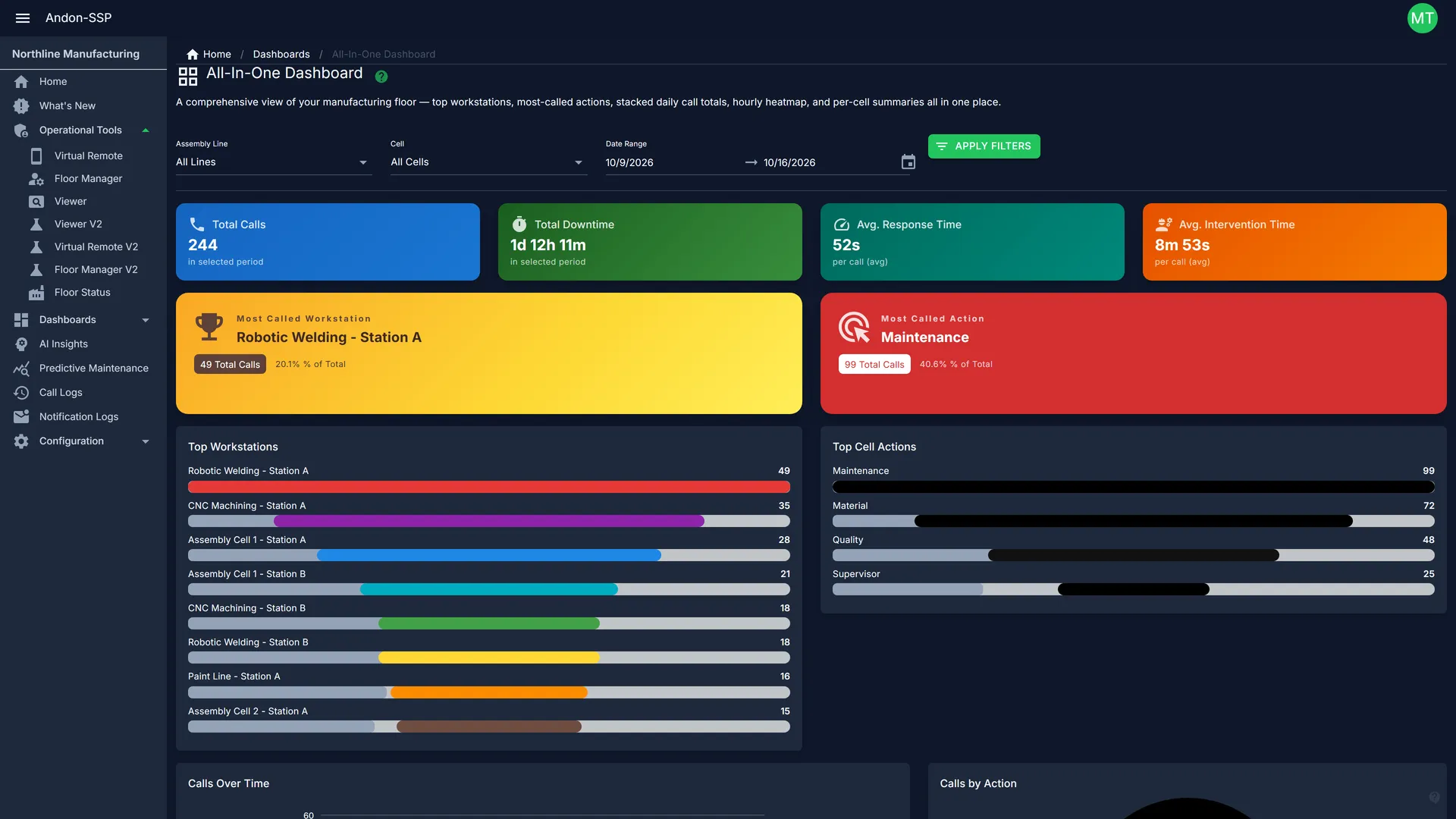
A stop has two parts: the time waiting for the right person, and the time fixing the problem. The fix depends on the problem. The wait depends on how fast the right person knows. That’s the part a call system shortens first: the right person is told right away, and if the call isn’t handled in time, someone else is told.
The other thing that changes is that you stop guessing. When every wait and every fix is recorded, you can rank your stops by what they really cost, and work on the biggest ones first.
Run your own numbers
Our downtime cost calculator does this math for you. Enter your stations, your shifts and the cost of a stopped hour, and see the yearly cost of waiting. If you want to see how Andon-SSP would measure it on your floor, book a 20-minute demo.
Want to see it on your floor?
In 20 minutes, we show you Andon-SSP set up with lines and call types like yours.